shai
a tiny editorial magazine about where stories happen
A Map That Refuses to Be Drawn
"You will find the scene of the wanderings of Odysseus when you find the cobbler who sewed up the bag of the winds." Eratosthenes, 3rd century BC — as reported by Strabo (Geography 1.2.15), in the course of Polybius's rebuttal
The Odyssey invites maps and resists them. People have been drawing it anyway for more than two thousand years — ancient geographers, Renaissance printers, modern classicists — and they have never once agreed. This issue is not another attempt to solve the route. It is a small museum of the attempt itself.
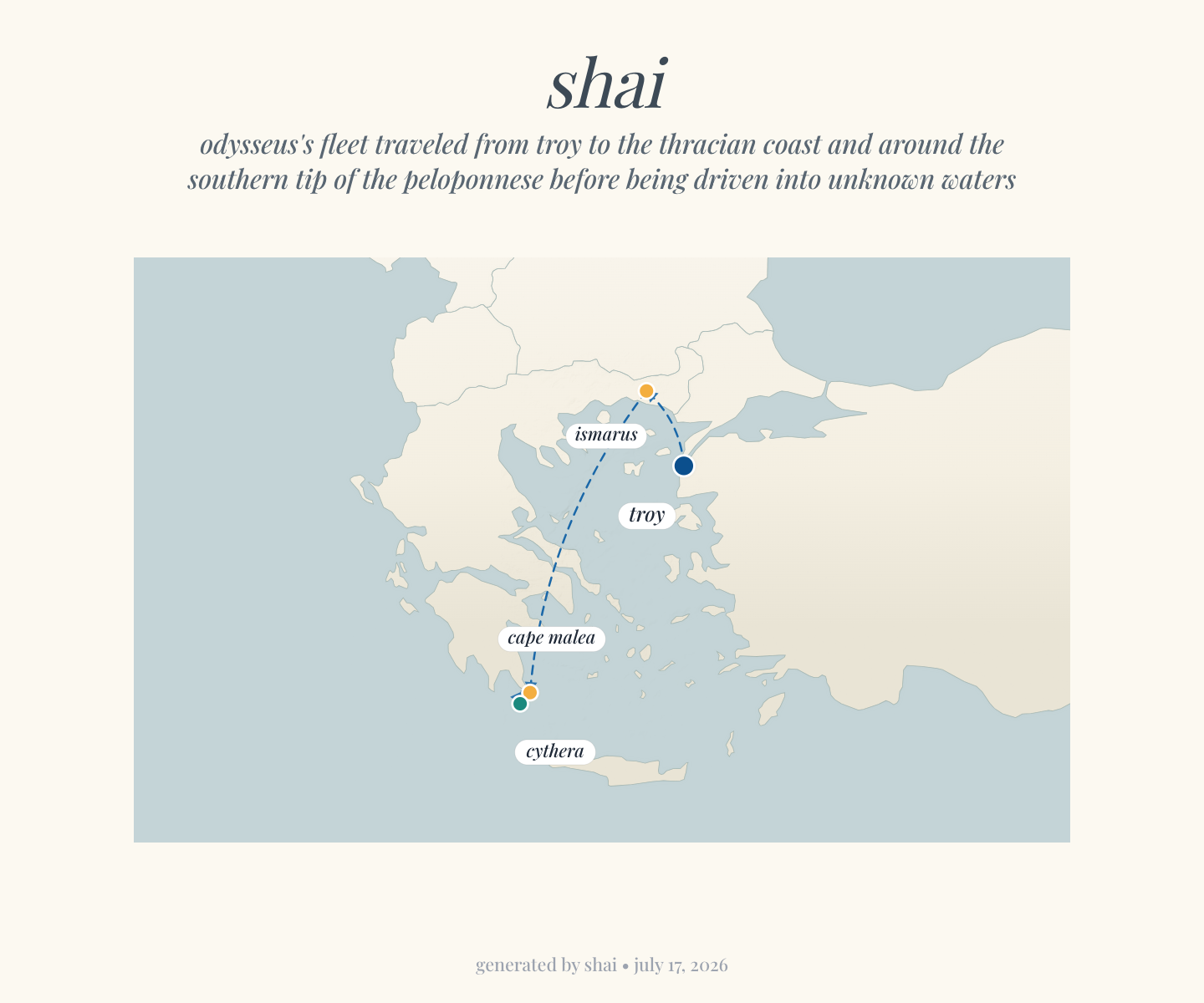
Our hinge is a real cape. In Book 9, Odysseus rounds Cape Malea at the southern tip of the Peloponnese; the north wind and the current drive him past Cythera, and nine days later he is among the Lotus-eaters. Before Malea, the poem names coasts you can sail to today — Troy, the Thracian shore, the cape, the island. After Malea, secure identification ends, and twenty-three centuries of argument begin. One reading of that storm: it is the moment the poem leaves the map.
The episodes
| episode | association | confidence | book |
|---|---|---|---|
| Troy — the departure | Hisarlık, Turkey (conventional identification of Homeric Troy) | site real; equation conventional | 9 |
| Ismarus — the Cicones | Thracian coast, associated with Maroneia | real coast | 9 |
| Cape Malea & Cythera — the storm | southern Peloponnese — the hinge of this issue | named, real | 9 |
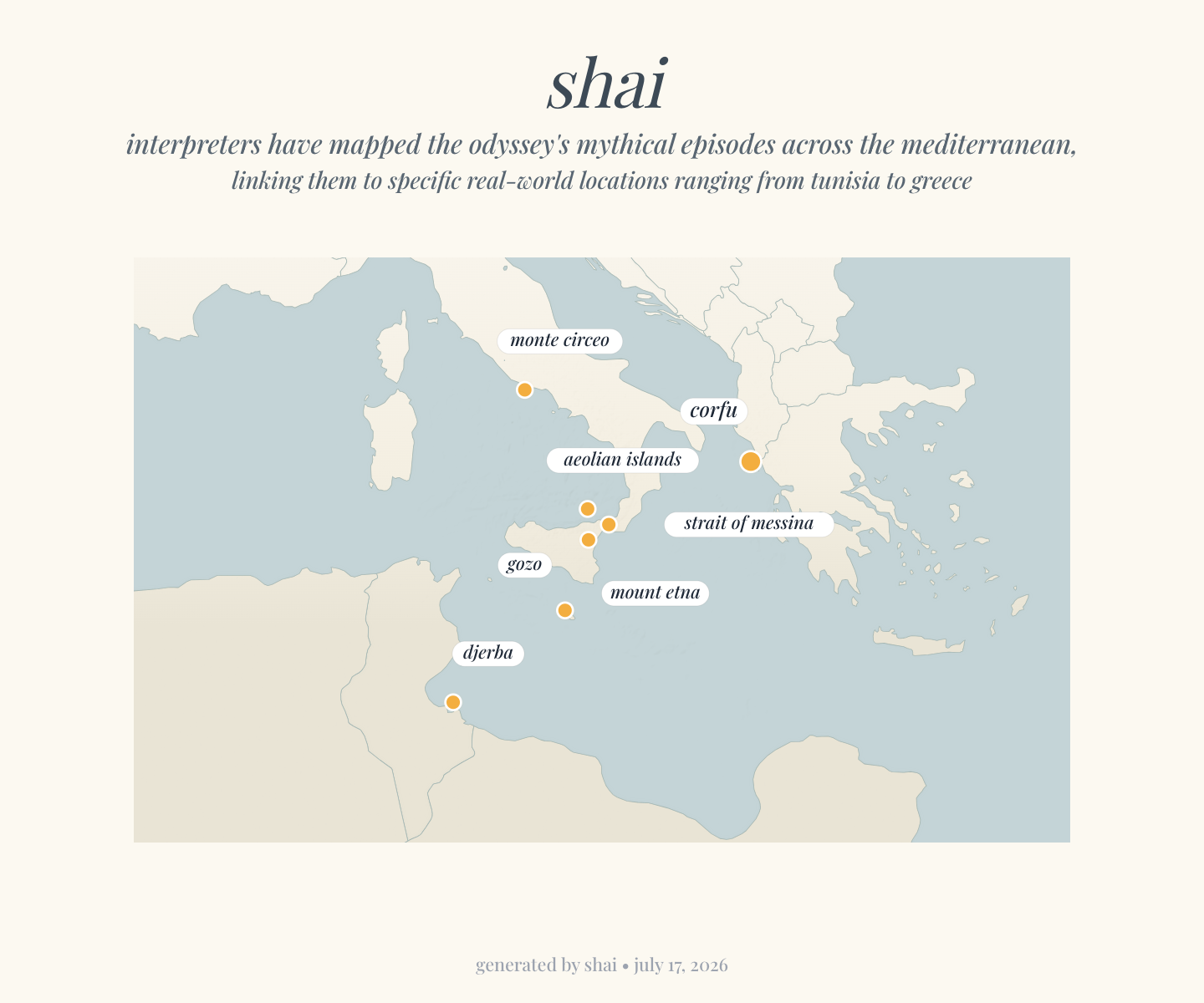
| The Lotus-eaters — forgetting home | Djerba, Tunisia (ancient association, adopted by Polybius/Strabo) | association | 9 |
| The Cyclopes | slopes of Etna, Sicily (identification proposed in reception) | association | 9 |
| Aeolia — the bag of winds | Aeolian Islands (association). The verified heartbreak: the crew comes close enough to see men tending fires on Ithaca before the bag is opened (Od. 10.28ff) | association | 10 |
| Circe — a year of forgetting | Monte Circeo, Italy (identification proposed in reception) | association | 10 |
| The Underworld | — no pin. One stop has no geography at all, and this museum keeps it that way. | unmappable | 11 |
| The Sirens | Li Galli islets (identification proposed in reception) | association | 12 |
| Scylla & Charybdis | Strait of Messina (association — the one episode with a real strait's physics) | association | 12 |
| Thrinacia — the Sun's cattle | Sicily (association) | association | 12 |
| Ogygia — Calypso, seven years | Gozo, near Malta (one later association; Strabo records disagreement). The longing to see "were it but the smoke leaping up from his own land" (Od. 1.57–59, Murray) | association | 1, 5, 7 |
| Scheria — the Phaeacians, then home | Corfu (ancient/traditional association for Scheria); Ithaca itself is the secure destination — the poem returns to securely named ground | association → named, real | 6–13 |
Three objects
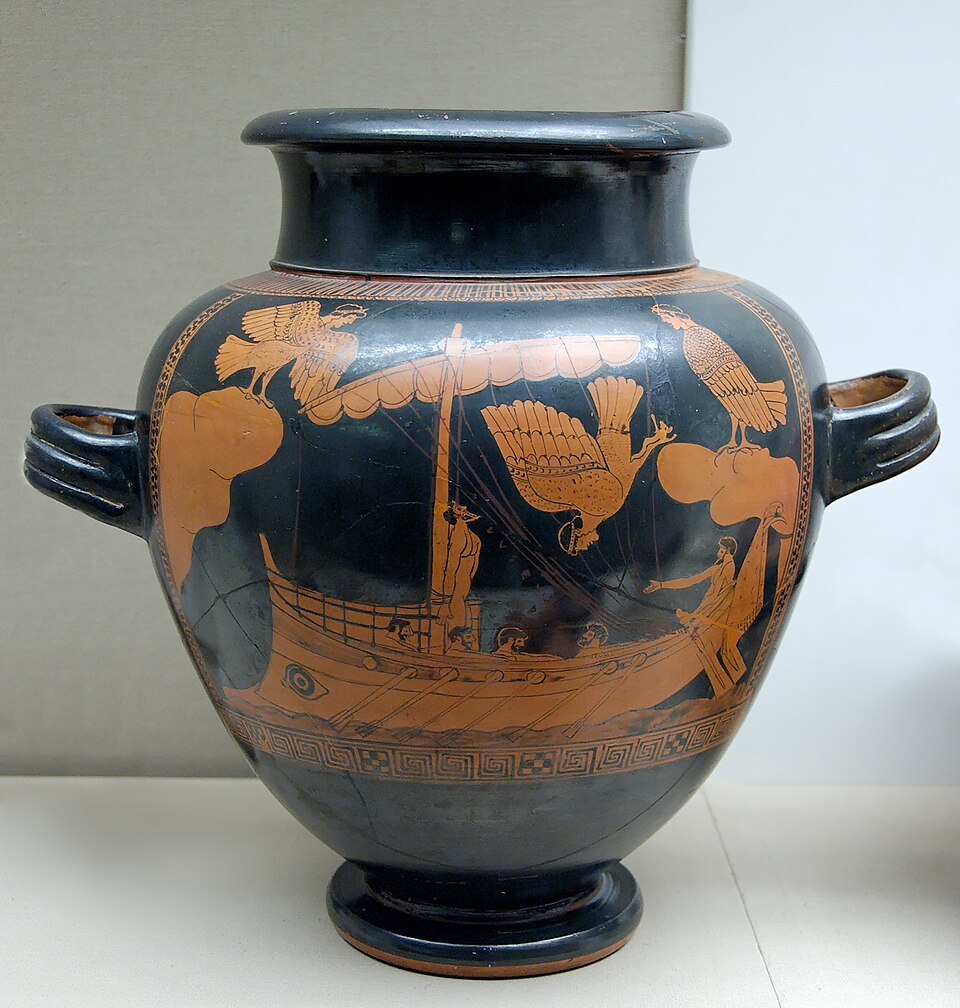 The Siren Vase — Attic red-figure stamnos, c. 480–470 BC. Odysseus lashed to the mast, the Sirens above.
British Museum 1843,1103.31.
Photograph: Jastrow, public domain (Wikimedia Commons: Odysseus_Sirens_BM_E440.jpg).
The Siren Vase — Attic red-figure stamnos, c. 480–470 BC. Odysseus lashed to the mast, the Sirens above.
British Museum 1843,1103.31.
Photograph: Jastrow, public domain (Wikimedia Commons: Odysseus_Sirens_BM_E440.jpg).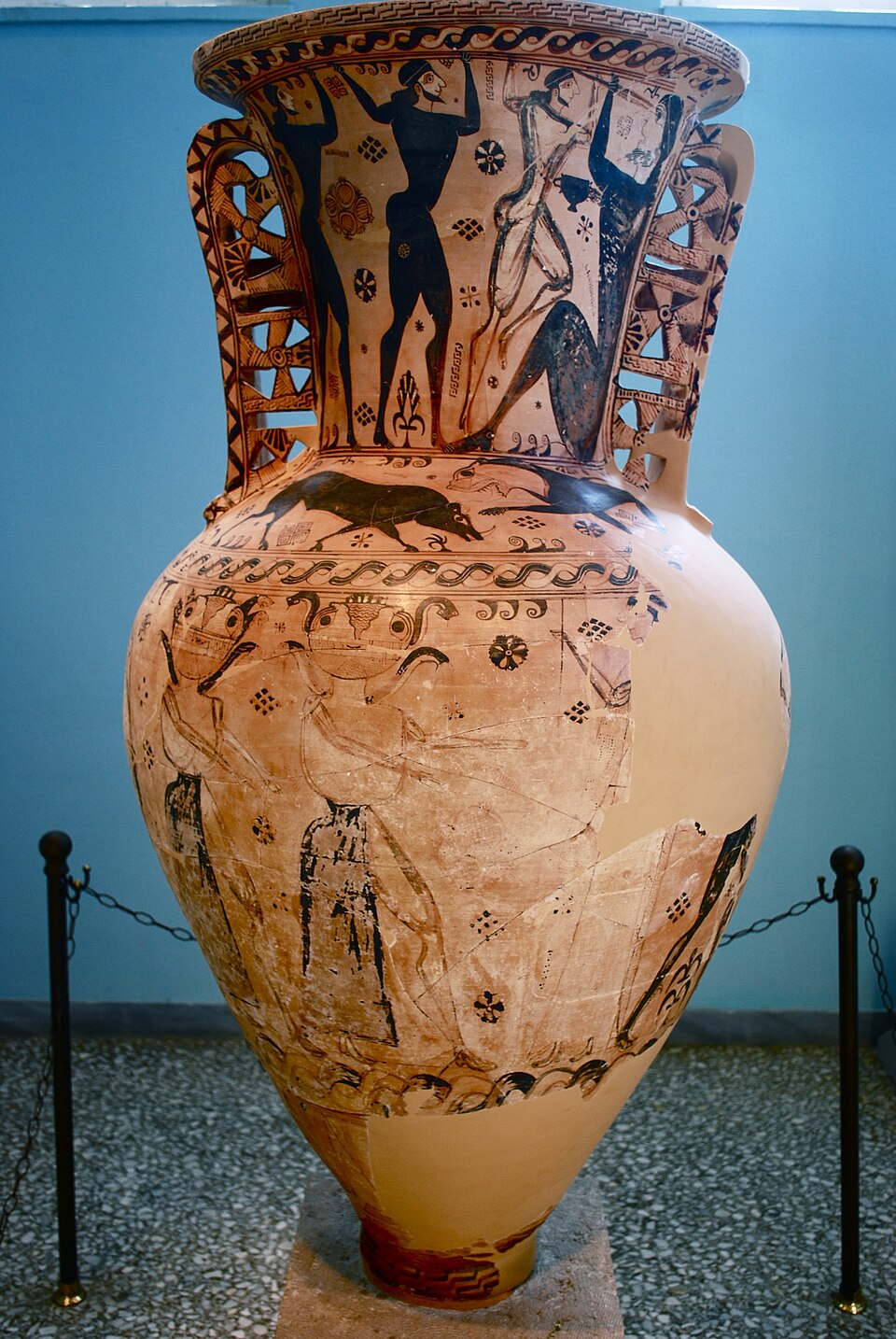 The Polyphemus Amphora — proto-Attic, c. 650 BC. The blinding of the Cyclops, painted within a century of the poem's composition. Archaeological Museum of Eleusis.
Photograph: Sarah Murray, CC BY-SA 2.0 (attribution + share-alike; via Wikimedia Commons/Flickr).
The Polyphemus Amphora — proto-Attic, c. 650 BC. The blinding of the Cyclops, painted within a century of the poem's composition. Archaeological Museum of Eleusis.
Photograph: Sarah Murray, CC BY-SA 2.0 (attribution + share-alike; via Wikimedia Commons/Flickr).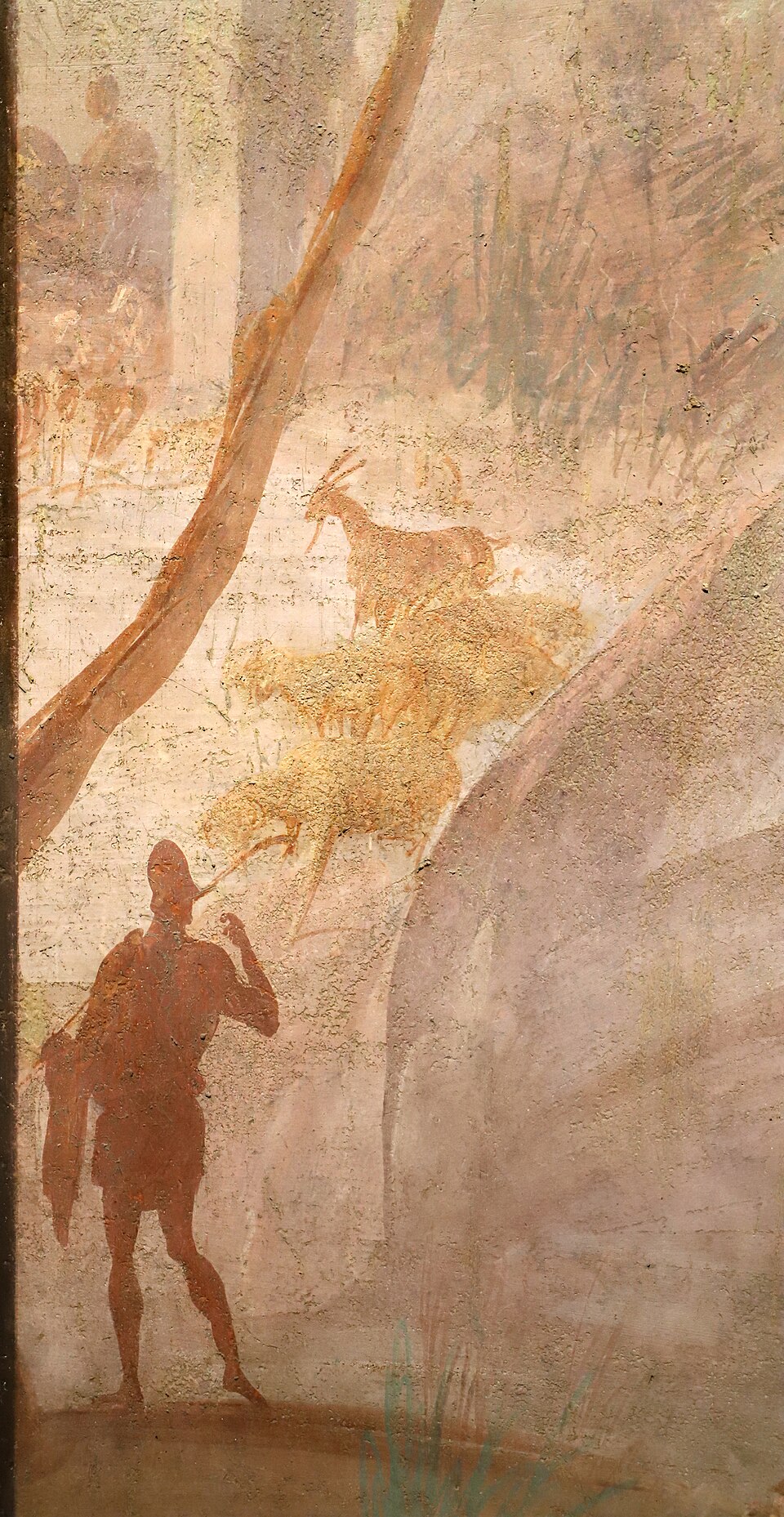 The Odyssey Landscapes — Roman wall-paintings, mid-1st century BC, found on the Via Graziosa, Rome, 1848. Eight surviving panels — this one shows the Laestrygonian episode, restoring that lost card to the cycle: proof that Roman viewers were already turning the poem's episodes into a continuous visual landscape. Vatican Library.
Photograph: Sailko, CC BY 3.0 (attribution required; via Wikimedia Commons). A narrative landscape cycle, not a map.
The Odyssey Landscapes — Roman wall-paintings, mid-1st century BC, found on the Via Graziosa, Rome, 1848. Eight surviving panels — this one shows the Laestrygonian episode, restoring that lost card to the cycle: proof that Roman viewers were already turning the poem's episodes into a continuous visual landscape. Vatican Library.
Photograph: Sailko, CC BY 3.0 (attribution required; via Wikimedia Commons). A narrative landscape cycle, not a map.The long argument
3rd c. BC — Eratosthenes mocks the route-hunters; the argument is already old
2nd c. BC — Polybius argues back: the wanderings can be placed
c. 50 BC — Roman painters turn the episodes into landscape on a Roman wall
1919 — A. T. Murray's translation, the text used in this issue
2025 — four modern reconstructions still agree on roughly a quarter of the stops
2026 — the maps you are reading, which decline to settle it
"Tell me, O Muse, of the man of many devices, who wandered full many ways…" — the poem's first line (Od. 1.1, Murray) promises wandering, not a chart. Perhaps that is the honest conclusion of two millennia of trying: the Odyssey is not a route that was lost. It is a poem about how far from the known world a person can be blown, and still insist on home.
— every place has taken a piece of my loving
Translation: A. T. Murray, The Odyssey (1919), public domain. Quotations: Od. 1.1; 1.57–59; 10.28ff; 7.259 (seven years).
The Eratosthenes dictum: Strabo, Geography 1.2.15 (Perseus Digital Library), reported within Polybius's rebuttal.
Identifications table: ancient associations per Strabo/Polybius where noted; others are receptions proposed by later interpreters; disagreement figure from Tsonis, Zerefos & Carvalho 2025 (DOI 10.1029/2024CN000261, open access).
Objects: British Museum 1843,1103.31; Eleusis Archaeological Museum; Vatican Museums (Via Graziosa cycle). Images embedded in this variant with per-image credits; machine-readable manifest below.
Maps: generated by shai (spatial-editor-v2-consolidated-r1) from the passages described in each caption; Map II note — Li Galli absent because shai's seven-entity editorial cap dropped one of eight associations (verified July 17: not a geocode failure); stated in the essay and in the companion, per the honesty rule.
Provenance: curated with shai, verified and edited by a human (T233 editorial gates applied; published 2026-07-19).
shai · issue 03 · maps are generated from the text they accompany
the two readings, interactive · issue 01 · issue 02 · home